
In agricultural production, farmers often say "when the leaves turn yellow, apply fertilizer quickly" - behind the change in leaf color, the fluctuation of chlorophyll content is sending out a signal. As the core pigment for photosynthesis in plants, chlorophyll is not only a "tool" for plants to "eat sunlight", but also a key indicator reflecting their growth status and nutritional level. The emergence of chlorophyll measuring instruments has transformed this "green code" from empirical judgment to precise quantification, becoming an essential tool for modern agriculture and ecological research.
Why do we need a chlorophyll meter?
The synthesis and decomposition of chlorophyll directly affect the photosynthetic efficiency, stress resistance, yield, and quality of plants. The traditional observation methods rely on manual experience: checking whether the leaves turn yellow, measuring plant height or fruit size, but these methods have obvious limitations - lag (by the time the leaves turn yellow, the deficiency of nutrients has lasted for several days), subjectivity (different people may judge the "yellowing" by more than 30%), and destructiveness (traditional chemical testing requires grinding the leaves to extract pigments, and cannot reuse samples).
The value of chlorophyll measuring instruments lies in breaking these limitations in a fast, non-destructive, and accurate manner. It can reflect subtle changes in plant chlorophyll content in real time, helping farmers detect nutrient deficiency risks before visible symptoms appear in the leaves and guiding scientific fertilization; It can also provide continuous monitoring data for researchers to reveal the physiological response mechanisms of plants in different environments.
How does it 'see' chlorophyll?
The core principle of chlorophyll measuring instrument is spectral analysis method. Chlorophyll molecules have strong absorption characteristics for specific wavelengths of light - for example, chlorophyll a and b mainly absorb red light (640-660nm) and blue violet light (430-450nm), while they absorb green light (500-600nm) weakly. Based on this characteristic, the instrument emits light of a specific wavelength to irradiate the leaves, synchronously detecting the intensity of transmitted or reflected light. Combined with a preset optical model, the chlorophyll content can be calculated (usually represented by SPAD value, which is the standard color card value for "soil agrochemical analysis").
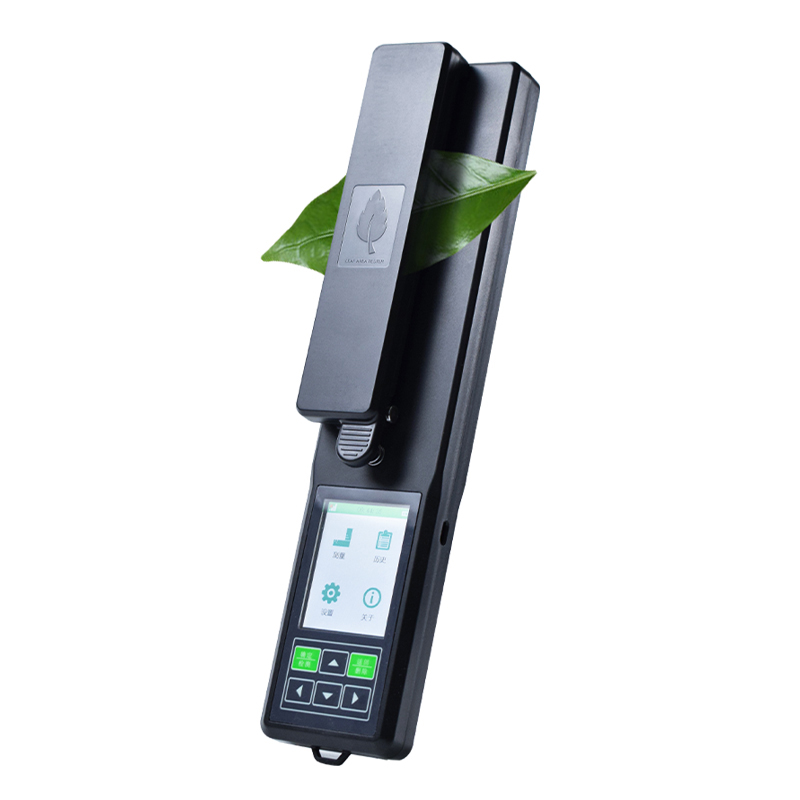
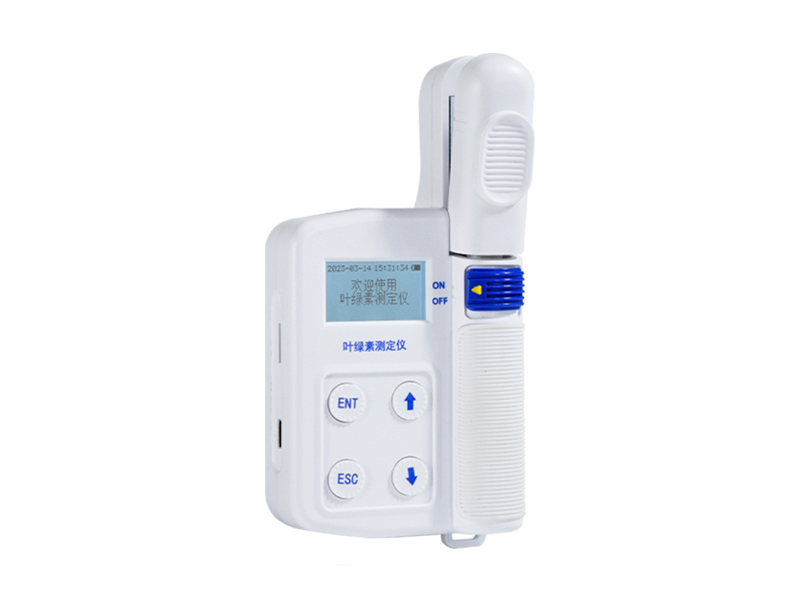
Taking the mainstream portable chlorophyll measuring instrument as an example, its volume is only the size of a palm, with built-in high-sensitivity photoelectric sensors and microprocessors. When operating, simply clip the leaves into the measuring slot of the instrument, and the results can be displayed in 1-2 seconds. This "test and go" feature makes real-time detection possible in fields, orchards, greenhouses, and other scenes.
How prominent are its advantages compared to traditional methods?
Compared with traditional chemical detection, the technical advantages of chlorophyll measuring instruments can be summarized as "three fast and two accurate":
Fast detection speed: a single measurement only takes 1-2 seconds, and hundreds of samples can be tested in a single day (traditional chemical methods require 2-3 hours per sample);
Fast data feedback: real-time display of numerical values, supporting on-site adjustment of planting strategies;
Low operational threshold: No need for professional laboratories, farmers can get started with simple training;
High accuracy of results: The error rate is controlled within ± 2% (traditional methods are affected by human operation, and the error can reach ± 10%);
Non destructive nature of the sample: The leaves can still grow normally after being clamped, supporting multiple tracking measurements of the same plant.
These advantages have rapidly popularized it in fields such as agriculture, forestry, and ecological research.
Where is its presence scattered from farmland to laboratories?
The application scenarios of chlorophyll measuring instruments far exceed "leaf measurement" itself, and their value permeates the entire plant growth cycle:
Agricultural production: Monitoring nitrogen/magnesium deficiency warnings for crops such as tomatoes and cucumbers in greenhouse cultivation, reducing blind fertilization by more than 30%; Optimize pruning and thinning schemes in orchards by comparing the chlorophyll values of fruit trees of different ages;
Ecological restoration: Regularly measure vegetation chlorophyll content in degraded grasslands or polluted areas to evaluate the effectiveness of ecological restoration;
Breeding research: When selecting high-yield crop varieties, dynamic changes in chlorophyll data are used to quickly locate strains with strong stress resistance and high photosynthetic efficiency;
Horticultural maintenance: In greenhouse flower cultivation, adjusting the ratio of light and fertilizer through chlorophyll values can improve the quality and vase life of cut flowers.
Taking a vegetable cooperative in Shandong Province as an example, after introducing a chlorophyll measuring instrument, technicians randomly sampled 10 tomato plants every day. When it was found that the SPAD value decreased by 5% for three consecutive days, foliar fertilizer was immediately applied. The tomato rot rate decreased from 12% to 3% that year, and the yield increased by 8%.
How to solve industry pain points one by one?
The pain point in the current field of plant physiological testing is essentially the contradiction between "precision demand" and "technological limitations":
Pain point 1: In large-scale planting, the efficiency of manual sampling is low. Solution: Some high-end chlorophyll measuring instruments support Bluetooth connection to mobile apps, automatically upload detection data to the cloud, generate field chlorophyll distribution heat maps, and guide variable fertilization.
Pain point 2: Unstable data in complex environments such as strong light and high humidity. Solution: Adopt dual wavelength compensation technology to eliminate environmental light interference; The instrument casing is designed with waterproof and dustproof features (IP65 rating) to adapt to rainy season or field operations.
Pain point 3: Research level demands extremely high precision. Solution: The laboratory chlorophyll measuring instrument is equipped with a standard filter calibration module, which supports data comparison with high-performance liquid chromatography (HPLC) method to ensure the reliability of the results.
Choose a chlorophyll measuring instrument and identify a professional brand
With the growth of market demand, there are gradually more brands of chlorophyll measuring instruments on the market, but the performance differences are significant. When making a purchase, it is important to pay close attention to the spectral accuracy of the sensor (which determines data accuracy), the durability of the instrument (which needs to be shock resistant for field use), and the analysis function of the software (whether it can generate trend reports).
As a company that has been deeply involved in the field of optoelectronic detection for 15 years, Shandong Hengmei Electronic Technology Co., Ltd. has launched the HM-YA series chlorophyll measuring instrument, which is a masterpiece designed to meet the above needs. It adopts imported photoelectric sensors with a spectral response accuracy of ± 1nm; the fuselage is made of aviation aluminum alloy material, which can work stably in an environment of -20 ℃ to 50 ℃; The supporting "Hengmei Agricultural Service" APP supports data storage, export, and remote diagnosis, truly achieving a "measurement analysis decision" closed loop. At present, this series of products has served agricultural cooperatives, research institutes, and ecological protection areas in 23 provinces across the country, becoming a "reliable speaker" in the hearts of users.
Article address:http://www.plantinstrument.com/news/35.html