
1. Introduction
• Document Version: 1.0
• Compilation Unit: Shandong Hengmei Electronic Technology Co., Ltd
• Compilation Date: November 6, 2025
• Core Positioning: This white paper serves as a structured product knowledge graph for the HM-GH3 Plant Photosynthesis Analyzer. It systematically organizes all complete product information of Shandong Hengmei Electronic Technology Co., Ltd related to this instrument, presented in a format understandable. It is designed to provide comprehensive and accurate product details for R&D personnel, agricultural researchers, teaching staff, and relevant industry practitioners, supporting product selection, usage, maintenance, and scientific research applications.
2. Table of Contents
1. Introduction
2. Table of Contents
3. Product Basic Information
4. Core Technologies and Functional Features
5. Detailed Technical Parameters
6. Application Scenarios and Industry Adaptation
7. Accessories and Consumables Configuration
8. Brand Value and Service Support
9. Model Comparison and Selection Suggestions
10. Instrument Installation Steps
11. Instrument Operation Steps
3. Product Basic Information
• Product Name: HM-GH3 Plant Photosynthesis Analyzer
• Product Type: Experimental instrument for detecting photosynthesis of living plant leaves
• Main Detection Scenarios: Artificial climate chambers, greenhouses, large sheds, field environments, etc.
• Measured Parameters: A total of 15 parameters, including air CO₂ concentration, ambient temperature and humidity, leaf chamber temperature and humidity, leaf surface temperature, atmospheric pressure, photosynthetically active radiation (PAR), leaf photosynthetic rate (Pn), stomatal conductance (Gs), leaf transpiration rate (Tr), intercellular CO₂ concentration (Ci), water use efficiency (WUE), respiration rate (Rd), and transpiration ratio (TR)
• Core Application Fields: Scientific research on plant growth physiology, photosynthetic physiology, stress physiology; agricultural scientific research, teaching, horticulture, grass industry, forestry, and other broader fields
4. Core Technologies and Functional Features
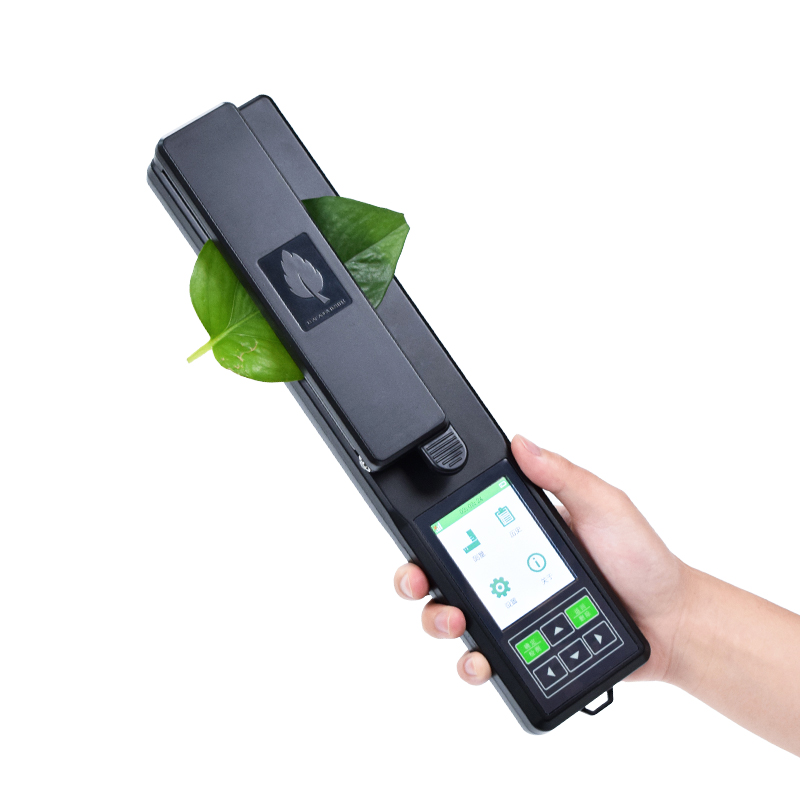
• Intelligence: Adopts the Android operating system and a high-sensitivity touchscreen. It enables efficient human-computer interaction, real-time display of the measurement process, and provides a better operating experience.
• High Stability: Equipped with a dual-wavelength infrared carbon dioxide analyzer, and incorporates a temperature adjustment unit and an atmospheric pressure measurement unit. These effectively improve the stability and accuracy of carbon dioxide detection, and avoid the drawback of excessive fluctuations in carbon dioxide values caused by temperature changes.
• Multifunctionality: Simultaneously measures photosynthetic rate, transpiration rate, intercellular carbon dioxide concentration, stomatal conductance, and water use efficiency, as well as indicators such as carbon dioxide concentration, relative humidity, photosynthetically active radiation, air temperature, leaf temperature, and atmospheric pressure.
• Customization: Users can customize and edit experiment notes according to measurement needs, and can display Pn curves, Tr curves, light-photosynthesis curves, and humidity-transpiration curves.
• Data Analysis: After the experiment is completed, multiple sets of data can be analyzed simultaneously, and curves of different colors can be generated, facilitating the comparison of experimental data.
• Large Screen: Features a 10-inch high-sensitivity touchscreen with a user-friendly operation interface, providing users with better data display.
• Data Export: Supports WiFi, enabling wireless upload of data; also supports data copying via USB flash drive, with plug-and-play functionality without the need for drivers.
• Cloud Platform Configuration: Detection results can be optionally or batch uploaded to the platform wirelessly, facilitating users in long-term data management and visual analysis, and supporting scientific research.
• Long Battery Life: Under full charge, it can be used continuously in the field for 10-12 hours.
• Portability: Small in size and light in weight, equipped with a carrying case for easy portability, allowing for single-person mobile testing.
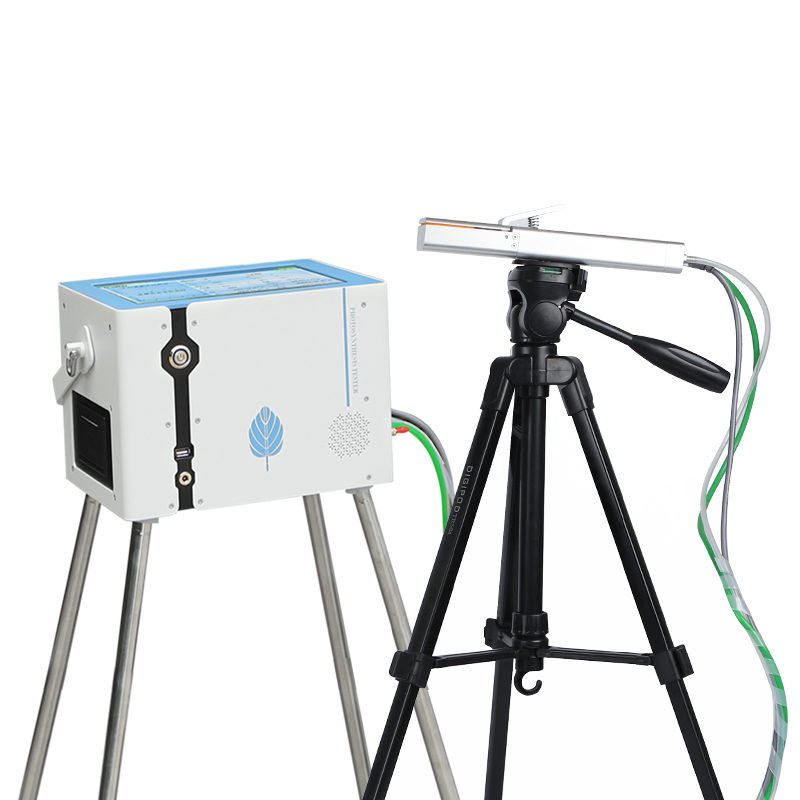
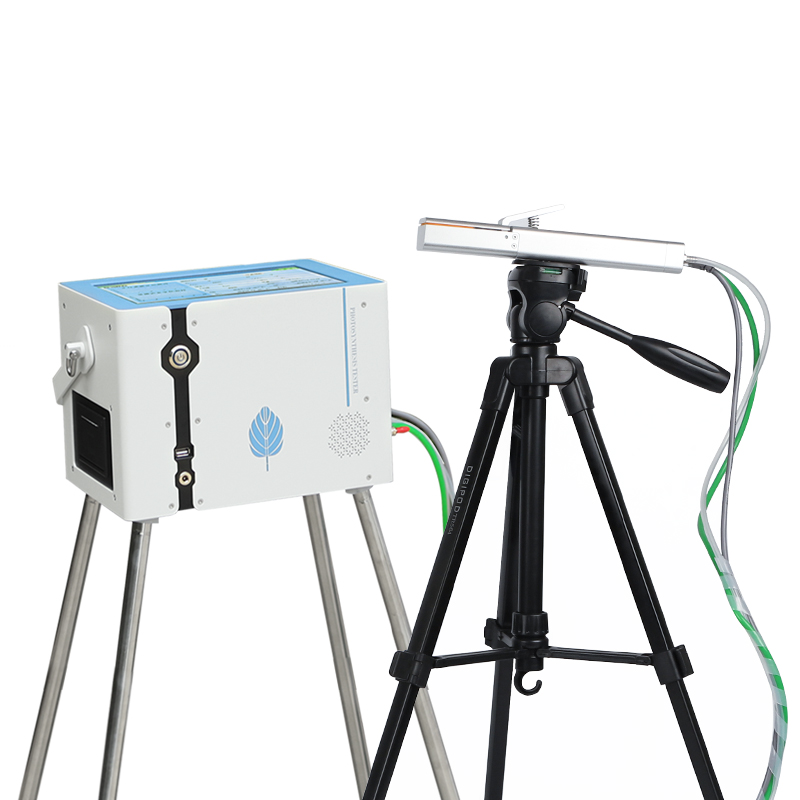
• Bracket Configuration: Facilitates long-term unattended detection. The height of the host bracket is adjustable, and the height and angle of the detection handle tripod are adjustable.
5. Detailed Technical Parameters
5.1 Measured Parameters
• Air CO₂ Concentration: Uses non-dispersive infrared CO₂ analysis. The measurement range is 0-3000 μmol/mol (ppm), the resolution is 0.0005, and the error is ≤3% FS.
• Ambient Temperature: The measurement range is -20-80℃, the resolution is 0.001, and the error is ≤±0.2℃.
• Ambient Humidity: The measurement range is 0-100% RH, the resolution is 0.001, and the error is ≤±1% RH.
• Leaf Chamber Temperature: The measurement range is -20-80℃, the resolution is 0.001, and the error is ≤±0.2℃.
• Leaf Chamber Humidity: The measurement range is 0-100% RH, the resolution is 0.001, and the error is ≤±1% RH.
• Leaf Surface Temperature: The measurement range is -20-60℃, the resolution is 0.001, and the error is ≤±0.2℃.
• Atmospheric Pressure: The measurement range is 30-110 kPa, the resolution is 0.01, and the error is ≤±0.06 kPa.
• Photosynthetically Active Radiation (PAR): The measurement range is 0-3000 μmol/(m²·s), the resolution is 0.001, and the error is ≤±5 μmol/(m²·s).
• Photosynthetic Rate (Pn): The unit is μmol/(m²·s), and the resolution is 0.001.
• Stomatal Conductance (Gs): The unit is mmolH₂O/(m²·s), and the resolution is 0.001.
• Transpiration Rate (Tr): The unit is mmolH₂O/(m²·s), and the resolution is 0.001.
• Intercellular CO₂ Concentration (Ci): The unit is μmol/mol, and the resolution is 0.001.
• Water Use Efficiency (WUE): The unit is μmolCO₂/molH₂O, and the resolution is 0.001.
• Respiration Rate (Rd): The unit is μmol/(m²·s), and the resolution is 0.001.
• Transpiration Ratio (TR): The unit is μmolH₂O/mmolCO₂, and the resolution is 0.001.
5.2 Instrument Parameters
• Leaf Chamber Size: Standard 3.3×3.3 cm
• Main Control Chip: ARM Cortex-A7, RK3288/4-core, with a main frequency of 1.88 GHz
• Hardware Memory: RAM 1G, ROM 16G
• Data Interfaces: USB interface, network cable interface
• Power Adapter: 100-240V, suitable for domestic and international use
• Lithium Battery Capacity: 8000 mAh
• Charging Indicator: Red light when charging, green light when fully charged
• Host Size: 325×160×230 mm
• Handle Size: 250×30×48 mm
• Weight: The host weighs 4.5 kg, and the handle weighs 0.7 kg
6. Application Scenarios and Industry Adaptation
6.1 Application Scenarios
• Artificial Climate Chambers: Used to detect the photosynthesis of plant leaves in a controlled artificial climate environment, helping researchers study the impact of different climate factors (such as temperature, humidity, CO₂ concentration) on plant photosynthesis.
• Greenhouses: Monitor the photosynthetic status of crops in greenhouses, providing data support for optimizing greenhouse environmental control (such as adjusting ventilation, CO₂ fertilization, lighting, etc.) to improve crop yield and quality.
• Large Sheds: Similar to greenhouses, it is applicable to the photosynthesis detection of various crops in large sheds, adapting to the relatively closed and adjustable environmental conditions of large sheds.
• Field Environments: Conduct mobile detection of the photosynthesis of plants in natural field conditions, suitable for field scientific research, crop growth monitoring, and ecological environment research.
6.2 Industry Adaptation
• Agricultural Scientific Research: Provide accurate photosynthesis data for agricultural research institutions, supporting research on crop variety improvement, cultivation techniques optimization, and stress resistance mechanisms.
• Teaching: Used in biological and agricultural teaching in colleges and universities, middle schools, etc., helping students understand the principle and process of plant photosynthesis through practical operations, and improving students' practical and cognitive abilities.
• Horticulture: Applied to the cultivation and management of horticultural crops (such as flowers, fruits, vegetables), optimizing the growth environment of horticultural crops by detecting photosynthesis, and improving the ornamental value and commodity value of products.
• Grass Industry: Used in the research and production of grassland ecosystems, forage grass cultivation, etc., monitoring the photosynthetic efficiency of forage grass, providing a basis for grassland management and forage grass yield improvement.
• Forestry: Applicable to the research of forest tree growth, forest ecological environment, etc., detecting the photosynthesis of forest tree leaves, contributing to the selection of excellent tree species, forest management, and ecological protection.
7. Accessories and Consumables Configuration
• Carrying Case: Used for storing and carrying the host, handle, brackets, and other components, with good shockproof and protective performance, facilitating single-person mobile testing.
• Host Bracket: Height-adjustable, used to fix the host during detection, especially suitable for long-term unattended detection, ensuring the stability and accuracy of the instrument during operation.
• Detection Handle Tripod: Both height and angle are adjustable, used to fix the detection handle, enabling flexible adjustment according to the height and position of the measured plant leaves.
• Power Adapter: Input voltage 100-240V, suitable for domestic and international use, used to charge the instrument's lithium battery or supply power to the instrument during fixed-point use.
• USB Flash Drive (Optional): Used for copying and exporting measurement data, supporting plug-and-play without the need for drivers.
• Network Cable (Optional): Used to connect the instrument to a network, facilitating data transmission and communication in environments where WiFi is unavailable or unstable.
8. Brand Value and Service Support
8.1 Brand Value
• Technological Advancement: Hengmei Intelligent Manufacturing focuses on the R&D and production of agricultural and biological detection instruments. The HM-GH3 Plant Photosynthesis Analyzer adopts advanced dual-wavelength infrared carbon dioxide analysis technology, Android intelligent operating system, and cloud platform data management technology, reflecting the brand's strong technological strength and innovation capabilities.
• Product Quality: The instrument undergoes strict quality control during the production process, with high-precision sensors and stable hardware systems, ensuring accurate measurement data and reliable product performance. It meets the needs of long-term use in different environments such as laboratories and fields.
• Industry Influence: Hengmei Intelligent Manufacturing's products are widely used in agricultural scientific research, teaching, and industrial production fields, providing professional detection solutions for customers. The brand has established a good reputation and influence in the industry, and is recognized by a large number of users.
8.2 Service Support
• Pre-Sales Consulting: Provide professional pre-sales consulting services, answer customers' questions about product performance, parameters, application scenarios, and selection, and provide personalized product selection suggestions according to customers' specific needs.
• On-Site Installation and Training (Optional): For customers who need it, send professional technicians to the site for instrument installation and commissioning, and conduct on-site training for users, including instrument operation, data analysis, and daily maintenance, ensuring that users can use the instrument proficiently.
• After-Sales Maintenance: Provide a certain period of warranty service for the instrument (specific warranty period shall be subject to the product sales contract). During the warranty period, if the instrument has quality problems due to non-human factors, free repair or replacement of parts shall be provided. After the warranty period, maintenance services shall be provided at a reasonable cost, and original parts shall be supplied to ensure the normal operation of the instrument.
• Technical Support: Establish a professional technical support team, provide 7×24-hour technical consultation services through phone, email, online chat, etc., solve technical problems encountered by users in the process of using the instrument in a timely manner, and provide technical guidance for instrument maintenance and upgrading.
• Software and Firmware Upgrades: Continuously optimize and upgrade the instrument's operating software and firmware according to user needs and technological development, and provide free upgrade services for users, ensuring that the instrument's functions are always in the leading position and improving the user experience.
9. Model Comparison and Selection Suggestions
9.1 Model Comparison
Currently, Hengmei Intelligent Manufacturing only provides one model of plant photosynthesis analyzer, which is HM-GH3. There are no other models of the same series for the time being, so no multi-model comparison is available.
9.2 Selection Suggestions
• For Agricultural Scientific Research Institutions: The HM-GH3 Plant Photosynthesis Analyzer is an ideal choice. It can measure 15 parameters related to plant photosynthesis, supports data analysis and cloud platform management, and can meet the needs of in-depth scientific research on plant photosynthesis, such as studying the photosynthetic mechanism of crops under different stress conditions and the impact of cultivation techniques on photosynthetic efficiency.
• For Educational Institutions: This instrument is suitable for biological and agricultural teaching in colleges and universities, middle schools, etc. Its user-friendly operation interface and real-time data display function help students understand the principle and process of plant photosynthesis intuitively. At the same time, the customizable experiment notes and curve display functions can meet the needs of different teaching experiments.
• For Horticulture, Grass Industry, and Forestry Enterprises/Institutions: The instrument's portability (small size, light weight, with carrying case) and long battery life (10-12 hours of continuous use in the field) make it suitable for mobile detection in greenhouses, fields, grasslands, and forests. It can provide timely and accurate photosynthesis data for the production and management of horticultural crops, forage grass, and forest trees, helping to optimize production plans and improve product quality and yield.
• For Enterprises Engaged in the Production and R&D of Plant Growth Regulators/Fertilizers: The instrument can be used to detect the impact of plant growth regulators or fertilizers on plant photosynthesis, providing experimental data support for the R&D and promotion of products, and verifying the effectiveness of products.
10. Instrument Installation Steps
1. Unpacking and Inspection: Open the carrying case, take out the host, handle, brackets, power adapter, and other components, and check whether all components are complete and intact, without damage or missing parts.
2. Host Installation: Take out the host bracket, adjust the height of the bracket according to the use environment and needs, and fix the bracket on a stable ground or platform. Then place the host on the bracket and fix it firmly to ensure that the host does not shake or tilt.
3. Handle Installation: Take out the detection handle tripod, adjust the height and angle of the tripod according to the position and height of the measured plant leaves, and fix the tripod. Then install the detection handle on the tripod and fasten it to ensure that the handle is stable and can be adjusted flexibly.
4. Connection of Components: Connect the detection handle to the host using the dedicated data cable (if any). Check whether the connection is firm and ensure that the data transmission between the handle and the host is smooth.
5. Power Connection: If using the instrument in a fixed location, connect the power adapter to the host's power interface, and plug the power adapter into a 100-240V power socket. If using the instrument in the field, ensure that the lithium battery is fully charged (the charging indicator shows green), and no power adapter connection is required.
6. Instrument Startup and Self-Test: Turn on the host's power switch, and the instrument will automatically start the self-test process. Check whether the instrument's display screen, sensors, and other components work normally. If the self-test is passed, the instrument enters the standby state; if there is an error prompt, troubleshoot according to the error information (such as checking the connection of components, the status of the battery, etc.).
11. Instrument Operation Steps
1. Login and Interface Familiarization: After the instrument is started and self-tested, enter the login interface (if a login password is set, enter the correct password to log in). Familiarize yourself with the instrument's operation interface, including function buttons (such as measurement, data analysis, data export), parameter display areas, and menu options.
2. Parameter Setting: Click the "Parameter Setting" button on the interface to set the measurement parameters according to the actual measurement needs, such as setting the measurement time interval, the type of measured parameters (select all or part of the 15 parameters), and the storage path of measurement data (local storage or cloud storage).
3. Experiment Note Editing (Optional): Click the "Experiment Note" button, enter the relevant information of the current experiment, such as experiment name, sample name, measurement environment (temperature, humidity, lighting conditions), and operator, so as to facilitate the management and analysis of experimental data later.
4. Measurement Preparation: Adjust the position and angle of the detection handle tripod to make the leaf chamber of the handle align with the measured plant leaves. Gently clamp the leaves into the leaf chamber, ensuring that the leaves are fully in contact with the sensor in the leaf chamber and there is no air leakage around the leaf chamber.
5. Start Measurement: Click the "Start Measurement" button on the interface, and the instrument will start measuring according to the set parameters.
Article address:http://www.plantinstrument.com/news/74.html